Widely available
Solar
Rooftops, public facilities, industrial surfaces and power plants, depending on land and grid capacity.
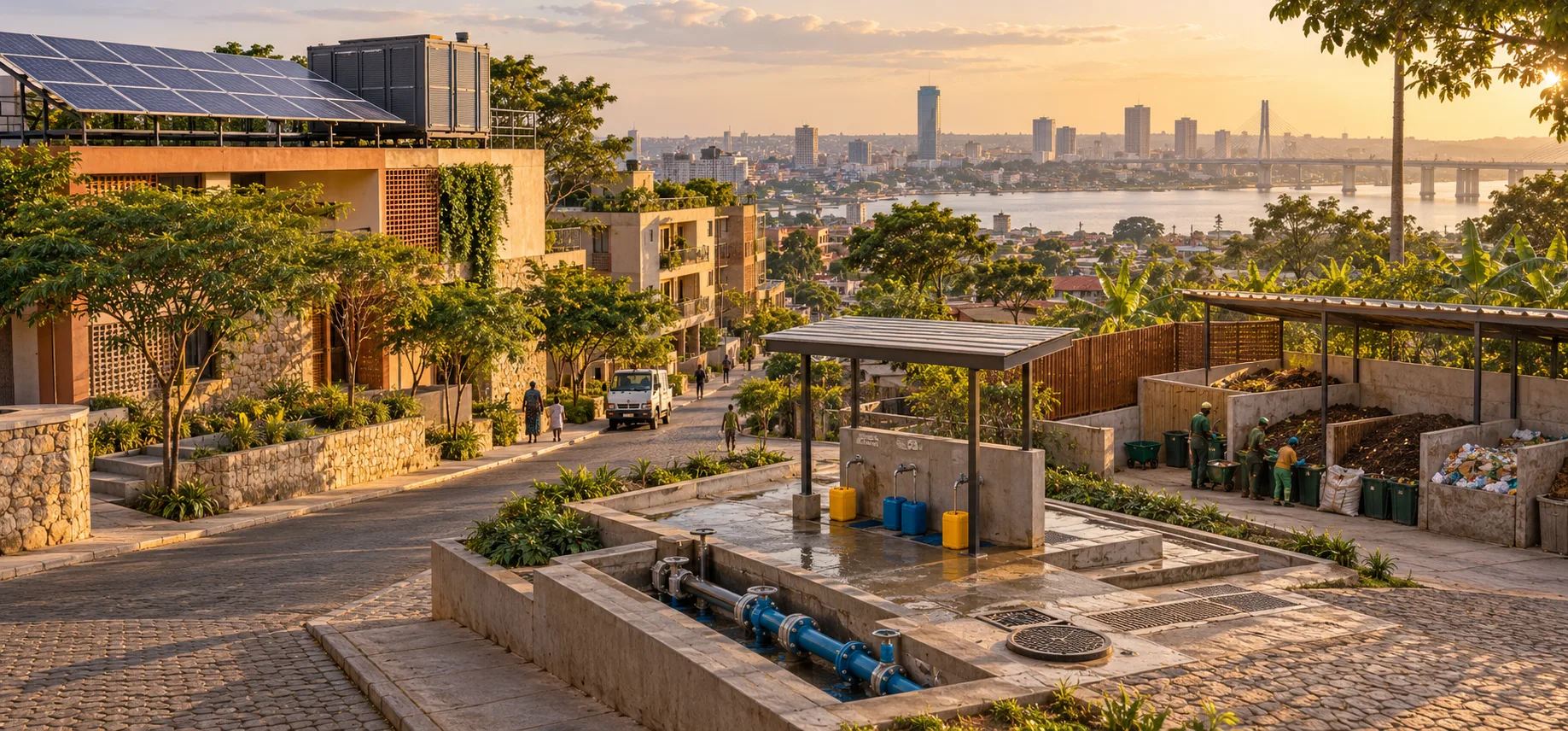
Vision · Pillar 01 · Sustainable mixed energy
The last century’s model, producing far away and distributing top-down, created dependencies and left regions behind. NOVASCEND explores another way: complementary sources, managed together, serving residents, industry, agriculture and essential services. It is the first pillar of the vision applied to energy.
01 · The paradigm shift
Electricity lights, heals, preserves, produces and teaches. Its absence, instability or cost limits the freedom to learn, do business, produce and live with dignity.
Population growth, industrialisation, access to services and climate vulnerability, all to be addressed at once.
No longer how many megawatts to produce, but which energy system for a society in transformation.
Energy considered from the design stage of cities, villages, industries and mobility: the local area becomes a place of production, storage, exchange and value creation.
Energy is one of the foundations of collective prosperity, not a mere commodity: that is the meaning of the pillar an economy that benefits the local area.
02 · Complementary resources
Sun, wind, water, biomass, geothermal: each resource has its own characteristics. Some vary with the hours and the seasons; others can be dispatched or stored.
Widely available
Rooftops, public facilities, industrial surfaces and power plants, depending on land and grid capacity.
As a complement
Diversifying generation where local conditions complement solar.
Depending on the water resource
Where relevant, while preserving ecosystems and water uses.
Organic residues
Residues turned into energy or heat, without competing with food, degrading soils or encouraging deforestation.
Depending on local conditions
Depending on geology, technology and economics; dispatchable or back-up capacity may remain necessary during the transition.
The rule of composition
Each local area builds its own combination according to its resources, its needs and its collective choices: a local, documented and revisable decision.
03 · Intelligent, resilient grids
Meeting demand at the right time, withstanding disruptions, maintaining essential services: NOVASCEND envisages interconnected grids, local microgrids, storage and digital management tools.
Combine several sources suited to the local area.
Manage variations with batteries, thermal storage or other relevant solutions.
Size grids and microgrids according to actual uses.
Use forecasts and consumption data to adjust generation and storage.
Provide for back-up supply, degraded modes and the cybersecurity of critical infrastructure.
Artificial intelligence can optimise; it replaces neither physical protections, nor safety automation, nor the responsibility of operators. The electrical substation is among the operating facilities of the urban model.
04 · Energy at the heart of the circular economy
Electricity generation supports a factory; the factory makes materials; buildings integrate energy equipment; some activities provide recoverable heat or residues that can be recovered.
| Sector | What energy links |
|---|---|
| Housing | Bioclimatic design, efficiency and local generation. |
| Industry | Processing of raw materials and local manufacturing. |
| Agriculture | Irrigation, refrigeration and food processing. |
| Mobility | Electric transport and charging planned with the grid. |
| Resources | Heat recovery and reasoned recovery of residues. |
These synergies require technical design, investment, operating rules and environmental assessment; they are not a given.
05 · From consumption to economic participation
NOVASCEND explores arrangements that bring together, under the applicable laws, private operators, public authorities, cooperatives and community participation vehicles. Energy sovereignty means being able to understand, control and steer the benefits of the system.
What local value could support
Collective facilities, training, regulated shareholdings, reinvestment of available surpluses, affordable access to energy.
Safeguard
Maintenance, debt, taxes and reserves first; any distribution of surpluses afterwards, within a transparent legal framework. The same conditions as for the community dividend in the vision.
06 · Energy intelligence serving local areas
The NOVASCEND platform could integrate interoperable microservices: a consolidated view of generation, storage, distribution and aggregated consumption, at every scale.
At building scale
At neighbourhood scale
At city scale
Between regions
Conditions: cybersecurity, interoperability, minimisation of personal data, transparency and human control, in line with the principles set by the vision. Designed, not built.
07 · A transition that respects local areas
A renewable installation uses materials, land, water and capital; operating it requires skills, maintenance and end-of-life management.
Emissions, biodiversity, social conditions, availability of resources, repairability and recycling of each system.
The impacts, the alternatives and the operators’ commitments must be known before any installation.
Land rights, existing uses and ecosystems must be taken into account.
08 · Building a new autonomy
Autonomy does not mean isolation: more means to decide, act and cooperate. Interconnections pool capacity and strengthen security of supply, where technical and regulatory conditions allow.
Smart Industrial City
A Smart Industrial City could become a hub for production, processing, storage and consumption.
Smart Industrial Villages
Smart Industrial Villages could deploy solutions suited to rural and agricultural activities and to public services.
A new way of inhabiting the world
Africa’s energy future will not be measured only in power plants and kilometres of lines, but in the reliability of electricity in hospitals, the possibilities open to local businesses, the preservation of resources and the participation of residents. Energy makes development possible; how it is organised determines who benefits.
And on the ground
This page describes a way of designing energy, not installations that have been built. The projects announced by WAGAS Group are tracked elsewhere, with their status.
More than 600 MW of renewable capacity in the pipeline, biomass units, a city powered by a renewable mix: the deployment state of play sets these announcements against what remains to be documented, project by project.
Clean energy is among the categories envisaged for green bonds, with the use of funds tracked asset by asset. No issuance has taken place.
Short answers on sources, continuity of service and the value created are gathered in the FAQ.