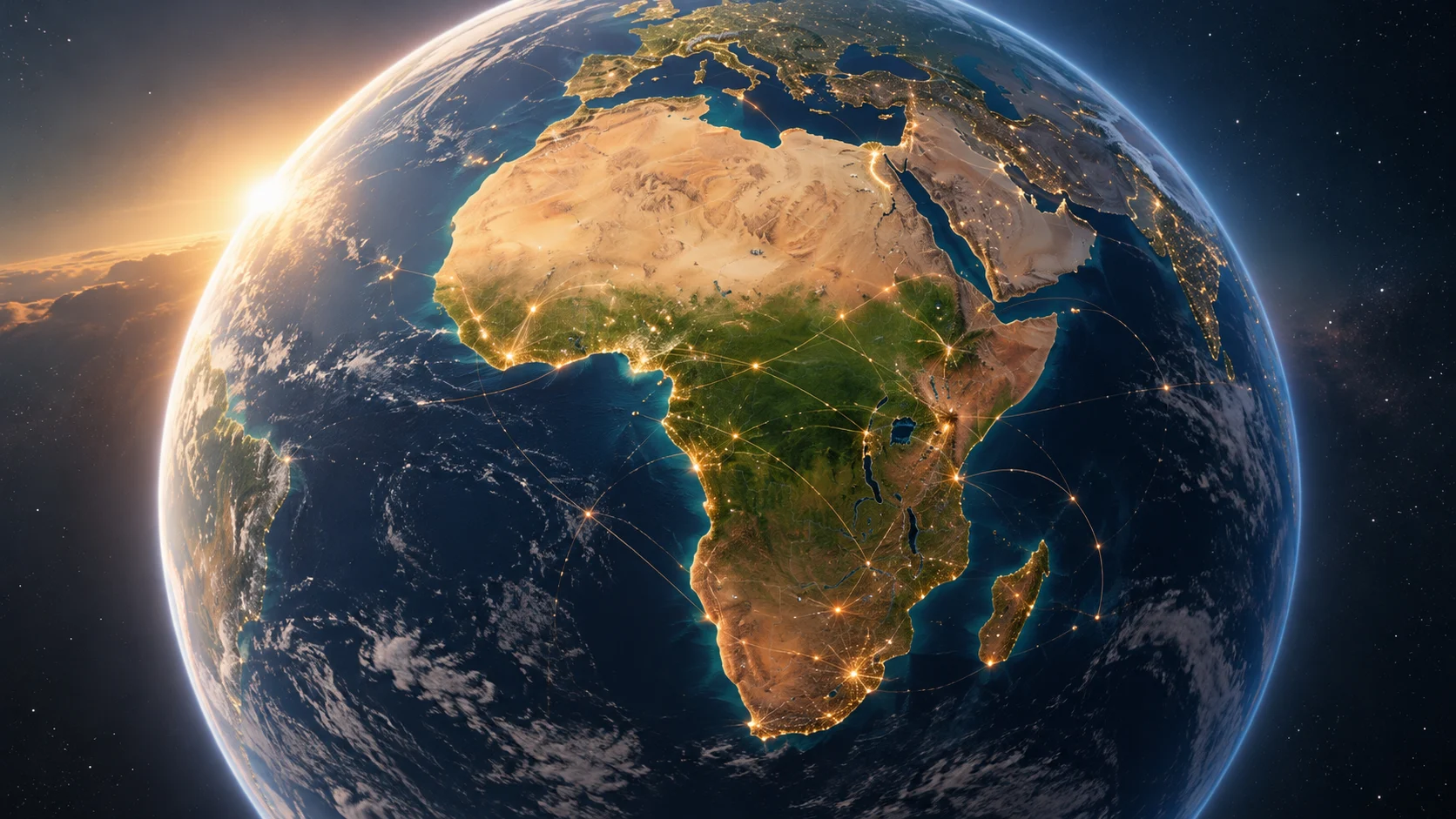




Editorial illustration: the Earth seen from high orbit, Africa at the centre, crossed by fine lines of light
Concept illustration · Generated image, not a photograph

Context · The world is changing

The world is changing. Africa can invent what comes next.

Between demographic growth, urbanisation and technological upheaval, the balance of the world is being redrawn. Africa can devise its own urban, economic and social models — and inspire well beyond the continent.

A historic convergence

Africa is growing just as work is being reinvented.

Demographic transition, the expansion of cities and the artificial intelligence revolution are happening at the same time. Their meeting opens a political possibility: making the growth of human capabilities and shared prosperity a matter of organisational choice rather than a presumed consequence of technology.

1.50 → 2.45 billion

African population, 2024 to 2050 · projection

AUC / OECD, 2025
700 M → 1.4 bn

African urban population by 2050 · projection

OECD and partners, 2025
4,4 %

African real GDP growth in 2025 · estimate

African Development Bank, 2026
82 %

Estimated share of African workers in informal employment

AUC / OECD, 2024

Reference sources

Organisations cited in this analysis. Their logos identify the sources of the data and do not mean that they endorse NOVASCEND.

01

Demographics & cities

A generation changes the scale of decisions.

Between 2024 and 2050, Africa is expected to gain nearly 950 million people. Over the same period, its urban population could double. Hundreds of millions of additional life paths will therefore need to be made possible: finding housing, getting around, learning, and gaining access to water, energy, health and a chosen activity. These needs concern the large metropolises, but also intermediate cities and the areas around them.

Urbanisation does not automatically create prosperity. How far ahead land, services and infrastructure are planned will determine whether cities become places of emancipation or reproduce exclusion and precarity. Climate constraints make these choices even more decisive.

02

Growth & employment

Turning growth into lived prosperity.

The African Development Bank estimates the continent’s real GDP growth at 4.4% in 2025. This momentum nonetheless conceals very different national situations. On its own, it does not say how many people gain stable employment, reliable services or the means to start a business.

According to the OECD, about 82% of African workers are in informal employment. The World Bank estimates that 10 to 12 million young people enter the labour market each year, while about 3 million formal jobs are created. The challenge is therefore to turn demographic energy into skills, local production and more evenly shared incomes, while recognising the value created outside conventional forms of employment. Source: World Bank, 2026

03

AI & work

AI, the new industrial revolution.

Artificial intelligence is a general-purpose technology whose potential effects the OECD compares to those of past industrial revolutions. It already affects tasks of writing, calculation, programming, design and analysis; with robotics, it may also change production and services. It thus transforms the organisation of intellectual work as much as that of manual work. Source: OECD, 2026

The ILO estimates that about one job in four worldwide has some degree of exposure to generative AI. This is a measure of task exposure, not a forecast of job losses: the transformation of occupations appears more likely than their disappearance. Productivity gains, risks of deskilling and the emergence of new activities will depend on choices about training, social protection and the sharing of value. Source: ILO, 2025

This revolution raises a deeper question: what do we want to entrust to machines, and what do we want to do with our time and our capacities? Judgement, care, creation, passing on knowledge and collective decision-making remain human responsibilities. Rethinking work therefore means discussing remuneration, freed-up time and the place given to contributions useful to the community. It is a social and political debate, still open, which the NOVASCEND vision seeks to make concrete.

04

Sovereignty & collective choices

Deciding who controls the tools and their effects.

The capabilities of AI will not be equally accessible. In 2025, according to the International Telecommunication Union, 36% of people used the Internet in its Africa region, compared with 74% worldwide. Developing AI also requires reliable electricity, networks, computing capacity, skills, representative data and tools adapted to local languages and realities. Source: ITU, 2025

Sovereignty hinges on the capacity to set the rules: who controls the data, who owns the infrastructure, who can challenge an automated decision, and where the value produced stays. The African Union has adopted a continental strategy for responsible AI suited to the continent’s priorities. For NOVASCEND, this question goes beyond digital technology: it also concerns economic, cultural and narrative control of development, with residents as the authors of their own solutions. Source: African Union, 2024

These figures are continent-wide estimates or projections unless otherwise stated. They do not describe each country in the same way, nor the results of the NOVASCEND project.