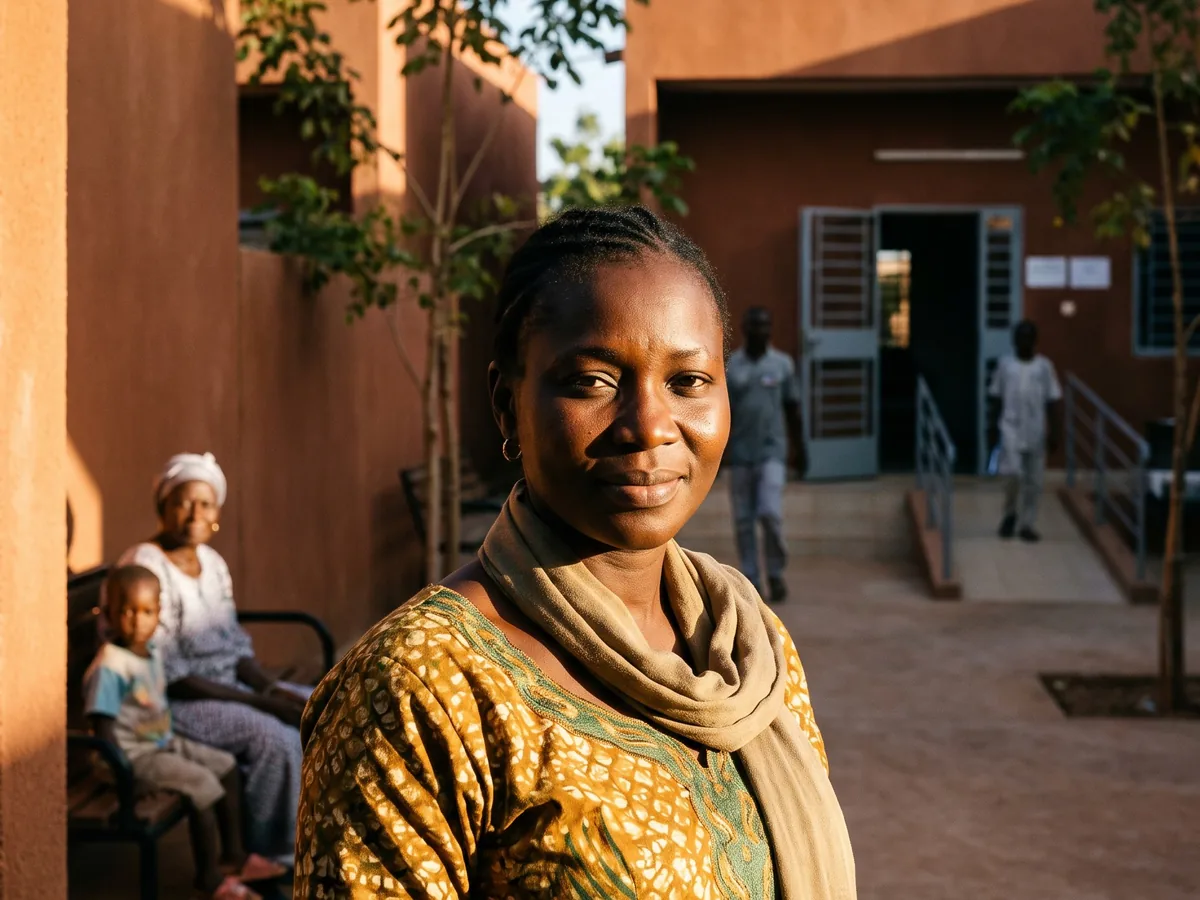
NOVASCENDImagined scene · Generated image, not a photograph
New lives · Six forward-looking stories
When the city opens the way to new lives.
Aïcha, Moussa, Fatou, Ibrahim, Aminata and Mireille are six fictional characters. Their journeys imagine what could become possible in a NOVASCEND city once built. Each shows how several service families could come together around a concrete life.
These six stories feature residents who could bring the NOVASCEND city to life in their own way. Click a portrait to enter their journey and see how places, services and other lives connect with one another.
Fictional character · concept illustration
From idea to activity
Aïcha, aged 22
Running freely could give her an idea for a business.
Aïcha would imagine a sports garment with a built-in payment device, so she could go running without a phone. In a neighbourhood fab lab, she would meet specialists, discover smart textiles and make a first prototype.
After testing with other athletes, she could take entrepreneurship training, find local suppliers and look for suitable funding. Her story shows how experimentation, skills and economic activity could come together without requiring substantial resources at the outset.
Proposed services and places: fab lab, mentoring, entrepreneurship training, introductions to suppliers and funding search.
Fictional character · concept illustration
Learning to act
Moussa, teacher
His classroom could become a neighbourhood laboratory.
To make science concrete, Moussa would ask his pupils to measure air quality around the school. They would learn to use sensors, analyse their observations and discuss solutions for certain spaces.
Their observations could be shared with residents and the services responsible for the environment, then followed over time. The school would not only pass on knowledge: it would help young people understand their environment and act on it.
Proposed services and places: teaching resources, environmental measurements, sharing of results and dialogue with the relevant officials.
Fictional character · concept illustration
Transforming resources
Fatou, community entrepreneur
Bio-waste could become the start of a cooperative.
Fatou would notice that her neighbourhood’s organic waste is rarely recovered. With a living lab, she would test a local collection and composting scheme, involve residents and use the compost in urban gardens.
A collection schedule, tracking of materials and outlets for the compost could help the cooperative organise itself. If the trial works and finds a viable model, the benefit would be ecological, economic and collective at once.
Proposed services and places: living lab, local collection and composting, tracking of materials, gardens and cooperative support.
Fictional character · concept illustration
Proposing and deciding
Ibrahim, active resident
A citizen’s proposal could change his neighbourhood.
Ibrahim would notice that young people have few spaces to meet and play sport. Through a participation scheme accessible by phone and in person, he would propose a multi-purpose public space.
His proposal would be discussed with residents and examined by the relevant officials. Public tracking of decisions would let him see what is accepted, modified or rejected, and why. If the location he had in mind were not chosen, the reason would be published and he could discuss it or propose another site. The proposal could then guide the design of the space and its rules of use.
Proposed services and places: proposals by phone or in person, assemblies and design workshops, public tracking of decisions.
Fictional character · concept illustration
Passing on and creating
Aminata, aged 67
Her skills as a seamstress could open up the future for others.
Aminata would join an intergenerational workshop to pass on techniques learned over decades. With young people, she would repair clothes, experiment with materials and imagine new creations.
A repair and reuse service could give this workshop a concrete follow-on, while fair pay would recognise her expertise. She could also help Aïcha develop her textile project. Her journey is a reminder that contributing to prosperity is not limited to salaried employment or to a particular age.
Proposed services and places: accessible workshop, training between generations, repair and reuse, fair pay for passing on skills.
Fictional character · concept illustration
Settling in and caring
Mireille, new resident
Settling in the city and caring for one’s family could be a single journey.
Mireille would arrive in the city with her two children and her mother, whose health requires regular follow-up. A welcome service for new residents would help her gather her documents, understand the conditions for access to housing and visit homes suited to her family, including one on the ground floor for her mother. The first home offered might not suit her: she could decline it without losing her place, her application remaining tracked according to allocation criteria known to all.
Once settled, she would book an appointment at the neighbourhood health centre by phone or in person, would be able, with her mother’s consent, to follow her mother’s care from one place to another, and would receive the children’s vaccination reminders. A carer support service would offer her respite hours to work or rest. Access to care would not depend on what she contributes to the community. Her journey is a reminder that housing, care and safety form the foundation on which other projects can rest.
Proposed services and places: welcome for new residents, procedures and documents, access to housing with published criteria, local health centre, shared care follow-up, carer support.
A single imaginary city
Six trajectories, one collective story.
Aminata could pass on her skills to Aïcha. Moussa’s pupils could contribute to the fab lab’s trials. Fatou and Ibrahim could use the same participation spaces. Mireille’s children could be in Moussa’s class. These six stories show part of the vision: getting around, or managing energy and water, would open up other journeys. Explore the eight service families.
What connects these lives matters as much as the services taken separately.